How Humidity Affects Masonry Chimneys (Even When It's Dry)
| Factor | Older/historic masonry | Modern masonry |
|---|---|---|
| Mortar binder | Lime-based, low or no Portland cement | Portland-cement-based, harder curing |
| Mortar flexibility | Softer, some self-healing of hairline cracks | Rigid once cured, cracks stay cracked |
| Brick type | Handmade or soft-mud, lower fire temperature | Extruded, wire-cut, higher fire temperature |
| Brick porosity | More absorbent, prone to spalling | Denser, less water uptake |
| Typical liner status | Often unlined, undersized, or original clay tile | Liner sized and installed to current standards |
| Repair priority | Match mortar chemistry, not just color | Standard modern mortar mixes generally compatible |
| Common failure pattern | Brick face spalling; joint self-healing can mask real deterioration | Joint cracking tends to precede brick damage |
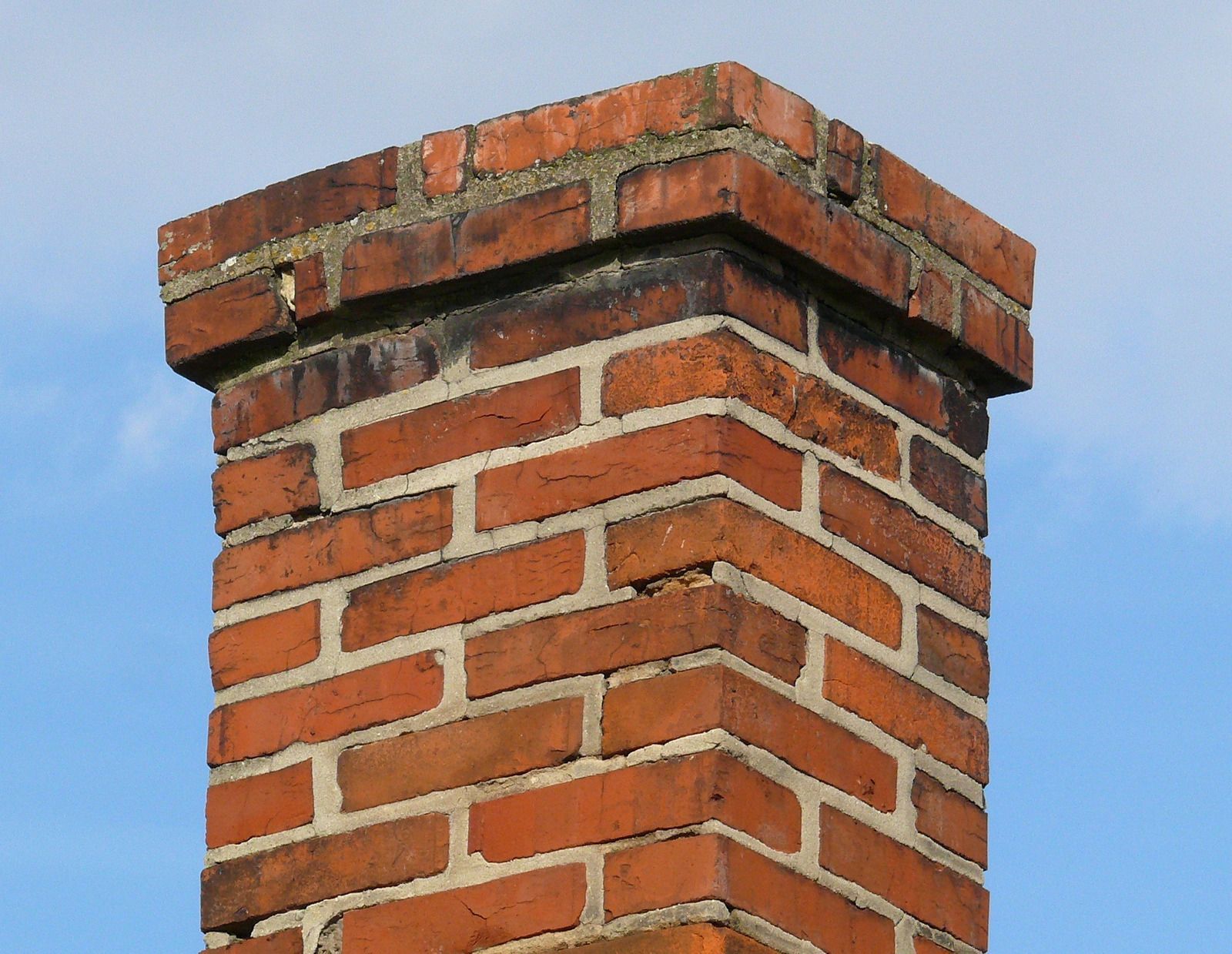
Older chimneys were often built on shallower footings than current standards call for, and after decades of ground movement and the chimney's own weight, some settling is common: a slight lean, a visible gap where the chimney meets the roofline, or a stair-step crack pattern following the mortar joints diagonally. A small, stable lean or an old, dormant crack isn't automatically an emergency, but telling "old and stable" from "active and worsening" benefits from a hands-on inspection rather than a guess from the ground.
A technician can often get a first read on mortar type without lab testing. Dragging a metal key or nail across a joint that leaves a visible scratch and a little powder points toward a softer, lime-rich mix, while a joint that resists scratching and holds a sharp edge points toward a harder, Portland-heavy mix. This test doesn't replace a proper inspection or lab analysis of the actual composition, but it's a useful first check before assuming a chimney can be treated like standard modern construction.
The damper is the movable plate that opens and closes the path between the firebox and the flue above it. Traditional dampers are a hinged metal flap mounted at the throat, right in front of the smoke shelf at essentially the same level; newer systems often use a top-mount damper instead, a sealing plate at the very top of the flue operated by a cable or lever from the firebox. The damper's job: it closes off the flue when there's no fire burning, so conditioned indoor air doesn't pour straight up the chimney, and it opens fully to let smoke and gases draft out when you do have a fire going. A damper that won't seat properly, whether warped, rusted, or coated in old creosote, wastes energy and can also affect how well a fireplace drafts once lit.
Hearth Extension
When a Post-Renovation Inspection Is (and Isn't) Warranted
The hearth extension, the noncombustible floor pad in front of the firebox opening, catches stray ash, bark, splinters, and the occasional ember that pops clear of the fire. A quick vacuum with a shop vac or a canister vacuum's brush attachment once a week during active burning keeps this debris from working into carpet fibers or wood flooring at the hearth's edge, and it's your chance to glance for embers that landed outside the firebox and cooled without your noticing. Check that logs, kindling, and any decorative items on the mantel or nearby furniture haven't crept closer to the opening than the several feet of clearance most fireplace manufacturers and fire-safety groups recommend as a baseline. This is also a good moment to make sure nothing- a rug corner, a stack of kindling, a pet bed- has migrated into that clearance zone since the last time you checked.
Waterproofing is a preventive and protective treatment for masonry that's fundamentally in good shape but exposed to the elements, not a repair for masonry that's already showing damage. If the brick or mortar has visible deterioration such as spalling, crumbling joints, or a cracked crown, that damage needs to be addressed on its own terms before waterproofing goes on top of it, since sealing over a compromised surface just locks moisture problems in rather than out. Once repairs are handled, waterproofing is a reasonable next step for extending the life of the masonry and reducing how much water it absorbs going forward, particularly on a chimney with no roof overhang or nearby shelter shielding it from direct weather. It's also a sensible addition anytime a chimney gets rebuilt or has significant tuckpointing done, since new mortar is at its most porous in the first year or two.
Set a glass of ice water on a porch table on a still, muggy afternoon and watch what happens within a minute or two: the outside of the glass beads over, then starts to run, even though nothing touched it but air. That water didn't fall from the sky. It condensed directly out of the surrounding air the instant it met a surface cooler than the air itself. A masonry chimney does something close to that same thing, at a slower pace and on a much larger scale, on plenty of days when the forecast never mentions rain at all.
Most homeowners think of chimney moisture as a rain problem: water hitting the crown, running down the flashing, soaking through a cracked cap. All of that matters, and it's covered elsewhere. This is about something that happens on the dry days in between, when the air itself is heavy with moisture, and the brick simply takes some of it in.
The Dew Point Is Doing Something to Your Chimney Right Now
Dew point is the temperature at which air, given how much moisture it's already holding, can't hold any more, so the excess condenses out as liquid water on whatever surface it touches. On a warm, humid day, the surrounding air might sit well above that threshold while a chimney's masonry, especially on a shaded side or overnight when the stack has had hours to cool, sits at or below it. Brick and mortar have a lot of thermal mass; they warm and cool slowly compared with the air around them, so there's often a stretch, most reliably in the early morning as air warms faster than the masonry does, when a stack is measurably cooler than the dew point of the air surrounding it.
When that gap exists, water vapor condenses on contact, the same way it does on the ice water glass, right on the surface of the brick and mortar joints. On a north-facing or heavily shaded face of the chimney, that surface can stay below the dew point for hours longer than a side that gets direct sun, which is one reason the same stack can look and feel noticeably damper on one face than another with no leak involved at all.
Masonry Doesn't Wait for Rain to Get Wet
Surface condensation is only part of it. Brick and mortar are hygroscopic, meaning the pore structure itself absorbs water vapor directly out of humid air, not just liquid water from rain running across the surface. Building scientists call the amount of moisture a material holds at a given humidity level its equilibrium moisture content: raise the relative humidity around a brick, and the brick's internal moisture content rises to match it, with no rain event required at all.
This is a different mechanism from the capillary action that pulls rainwater into masonry through surface pores, though the two work together. A stretch of muggy weather with a relative humidity sitting in the 70s or higher for days at a stretch can push a chimney's baseline moisture content up on its own, so by the time an actual rain event arrives, the masonry is starting from an already-elevated moisture level rather than a dry one. That matters because a chimney that starts wetter absorbs the next rain faster and holds it longer.
Why a Humid Climate Never Lets Masonry Fully Dry Out
Evaporation depends on a gradient: moisture moves from a wet surface into the surrounding air only as fast as that air is willing to accept it, and how much air is "willing to accept" comes down to how humid it already is. In a drier climate, a saturated chimney gets a real window to shed that moisture back into the air between weather events. In a persistently humid one, the air is often close to its own moisture capacity already, so the gradient driving evaporation off the brick stays weak for days or weeks at a time.
The practical result is a masonry chimney that spends more of the year sitting somewhere in the damp middle, never fully dry, rather than cycling cleanly between wet and dry. Freeze-thaw cycling does its own separate kind of damage by expanding trapped water inside the pores hard enough to crack the brick face; that's a mechanical problem tied to cold snaps. What's happening here is different: it's the masonry simply staying damper for longer stretches, which is a moisture-retention problem that can show up in any season a humid air mass sits over the area for a while.
What a Chronically Damp Chimney Actually Feels Like
Masonry that never fully dries out creates conditions for a musty, mildewy smell to develop inside the firebox and flue, particularly where airflow is limited, since sustained dampness combined with organic residue such as old creosote gives mold and mildew something to work with. It's also part of why a chimney that just got rained on can take noticeably longer to dry out in a humid stretch than the same chimney would after the same rain during a drier week: the ambient air isn't pulling moisture back out nearly as fast.
This piece deliberately isn't a symptom checklist. The visible signs of chimney water damage, efflorescence staining, spalled brick faces, rust on metal components, and crown cracking are their own topic and worth reading on their own. So is waterproofing, the actual treatment applied to reduce how much water a chimney's masonry takes on. What matters here is the mechanism underneath both of those: a humid climate keeps brick and mortar carrying more residual moisture, more of the time, than a drier one would, which is the reason a chimney in a consistently muggy area can need attention on a schedule a drier-climate chimney wouldn't.
Frequently Asked Questions
Can my chimney actually be absorbing moisture on a day with zero rain in the forecast?
Yes. Hygroscopic masonry absorbs and releases vapor continuously in response to the surrounding humidity, not just above some fixed threshold, so a run of muggy, rain-free days can leave a chimney measurably damper than it was a week earlier with no rain involved at all. Once conditions improve, that moisture doesn't leave immediately either; dense masonry can take several dry, sunny days in a row to fully release what it picked up during a prolonged humid stretch, which is why a chimney can still read damp well after the weather has already cleared.
Does the type of mortar change how much ambient humidity affects the chimney?
Yes, meaningfully. Older lime-based mortar is more vapor-open than the Portland cement mixes used in most homes built in the last several decades, meaning it absorbs and releases moisture vapor more readily. That makes a lime-mortar chimney more responsive to day-to-day humidity swings, though it also tends to dry out a bit faster once conditions improve.
Can indoor humidity or the appliance itself add moisture to the chimney from the inside?
It can, particularly with gas fireplace inserts. Burning natural gas produces a meaningful amount of water vapor as a byproduct of combustion, and in a masonry flue that runs cooler than a metal liner, some of that vapor can condense on the interior flue walls rather than venting out fully as gas, adding to the moisture the masonry is already carrying from outside.
How does a technician actually measure this instead of guessing?
A pin-type or pinless moisture meter reads the masonry's internal moisture content directly, and comparing readings across different faces of the stack (sun-exposed versus shaded) usually confirms whether ambient absorption, not a leak, explains a higher-than-expected reading. A Level 2 video inspection of the flue interior can also catch condensation staining that never reaches the exterior brick at all.
Does shade or nearby landscaping make this worse?
It can. Trees or shrubs close to the stack block direct sun and reduce airflow across the masonry surface, keeping that section of brick cooler and the air right around it more humid than the rest of the property. That combination extends how long the surface sits below the dew point on any given morning, independent of the broader climate.
Is there any way to stop masonry from absorbing ambient humidity entirely?
Not entirely, since brick and mortar are porous by design and that's part of what makes masonry breathe properly. A vapor-permeable water repellent reduces how much liquid and vapor moisture the pores take on without sealing the material shut, which is the approach used when a chimney's exposure calls for it; that product and process are their own separate topic.
Rain gets blamed for most chimney moisture problems because it's the visible one, but much of what keeps masonry damp happens on ordinary humid days nobody thinks twice about. Understanding that mechanism is the difference between chasing a leak that isn't there and recognizing a chimney that simply needs a moisture check as part of its regular upkeep.
Schedule a chimney moisture check — a CSIA-certified technician can measure your masonry's actual moisture content and tell you whether ambient humidity or an active leak is behind it. Perfect Chimney Cleaning serves Greensboro, High Point, and Winston-Salem. Call (336) 604-6711.
Recent Posts