How to Read a Chimney Inspection Report Without Guessing
The first sign most homeowners notice isn't rain at all. It's a faint tapping behind the damper during a storm, or a ring of gray water sitting in the firebox the next morning with no obvious source, because the roof is dry and the gutters are clear. The chimney itself is the leak. What that one morning shows is only the first frame of a much longer sequence, though: an open flue doesn't do the same damage on night one that it does after three winters of the same neglect, and which stage you're looking at changes what actually needs fixing.
What follows is the order in which damage actually occurs, from the top of the stack down to the framing behind the wall, and from the first storm to years of neglect. This is about a flue with no cap at all; a cap that's present but too small or the wrong shape for what it's covering is a separate problem with its own failure pattern.
| Factor | Older/historic masonry | Modern masonry |
|---|---|---|
| Mortar binder | Lime-based, low or no Portland cement | Portland-cement-based, harder curing |
| Mortar flexibility | Softer, some self-healing of hairline cracks | Rigid once cured, cracks stay cracked |
| Brick type | Handmade or soft-mud, lower fire temperature | Extruded, wire-cut, higher fire temperature |
| Brick porosity | More absorbent, prone to spalling | Denser, less water uptake |
| Typical liner status | Often unlined, undersized, or original clay tile | Liner sized and installed to current standards |
| Repair priority | Match mortar chemistry, not just color | Standard modern mortar mixes generally compatible |
| Common failure pattern | Brick face spalling; joint self-healing can mask real deterioration | Joint cracking tends to precede brick damage |
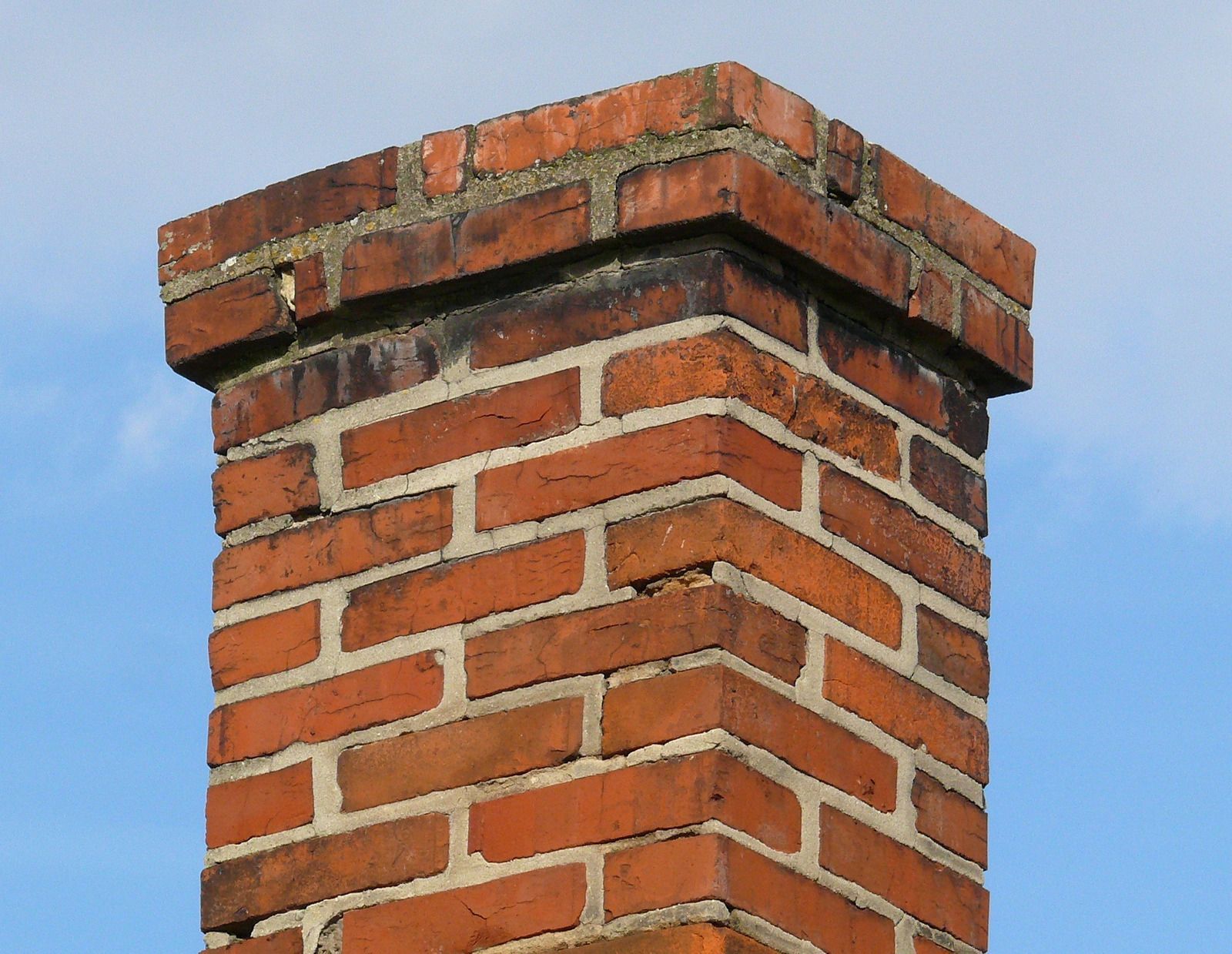
Older chimneys were often built on shallower footings than current standards call for, and after decades of ground movement and the chimney's own weight, some settling is common: a slight lean, a visible gap where the chimney meets the roofline, or a stair-step crack pattern following the mortar joints diagonally. A small, stable lean or an old, dormant crack isn't automatically an emergency, but telling "old and stable" from "active and worsening" benefits from a hands-on inspection rather than a guess from the ground.
A technician can often get a first read on mortar type without lab testing. Dragging a metal key or nail across a joint that leaves a visible scratch and a little powder points toward a softer, lime-rich mix, while a joint that resists scratching and holds a sharp edge points toward a harder, Portland-heavy mix. This test doesn't replace a proper inspection or lab analysis of the actual composition, but it's a useful first check before assuming a chimney can be treated like standard modern construction.
The damper is the movable plate that opens and closes the path between the firebox and the flue above it. Traditional dampers are a hinged metal flap mounted at the throat, right in front of the smoke shelf at essentially the same level; newer systems often use a top-mount damper instead, a sealing plate at the very top of the flue operated by a cable or lever from the firebox. The damper's job: it closes off the flue when there's no fire burning, so conditioned indoor air doesn't pour straight up the chimney, and it opens fully to let smoke and gases draft out when you do have a fire going. A damper that won't seat properly, whether warped, rusted, or coated in old creosote, wastes energy and can also affect how well a fireplace drafts once lit.
Hearth Extension
When a Post-Renovation Inspection Is (and Isn't) Warranted
The hearth extension, the noncombustible floor pad in front of the firebox opening, catches stray ash, bark, splinters, and the occasional ember that pops clear of the fire. A quick vacuum with a shop vac or a canister vacuum's brush attachment once a week during active burning keeps this debris from working into carpet fibers or wood flooring at the hearth's edge, and it's your chance to glance for embers that landed outside the firebox and cooled without your noticing. Check that logs, kindling, and any decorative items on the mantel or nearby furniture haven't crept closer to the opening than the several feet of clearance most fireplace manufacturers and fire-safety groups recommend as a baseline. This is also a good moment to make sure nothing- a rug corner, a stack of kindling, a pet bed- has migrated into that clearance zone since the last time you checked.
Waterproofing is a preventive and protective treatment for masonry that's fundamentally in good shape but exposed to the elements, not a repair for masonry that's already showing damage. If the brick or mortar has visible deterioration such as spalling, crumbling joints, or a cracked crown, that damage needs to be addressed on its own terms before waterproofing goes on top of it, since sealing over a compromised surface just locks moisture problems in rather than out. Once repairs are handled, waterproofing is a reasonable next step for extending the life of the masonry and reducing how much water it absorbs going forward, particularly on a chimney with no roof overhang or nearby shelter shielding it from direct weather. It's also a sensible addition anytime a chimney gets rebuilt or has significant tuckpointing done, since new mortar is at its most porous in the first year or two.
Reading Your Results
| Red Flag | What a Legitimate Technician Does Instead |
|---|---|
| Rock-bottom advertised price, then "mandatory" add-ons once the tech is on-site | States the base price and what could change it before the appointment; add-ons are optional and explained, not sprung |
| Claims of imminent fire or CO danger with no proof | Shows photos or video tied to the specific finding, or explains it in plain language you can follow |
| Vague or evasive about certification and training | Names the certifying body (e.g., CSIA), can describe what the credential covers |
| No mention of insurance, no findable business address | Carries liability coverage and can provide proof if asked; operates from a verifiable business |
| Refuses to show camera footage or "you wouldn't understand it" | Walks you through findings, translating technical detail into plain terms |
| "This price is only good if you sign today" | Gives you time to think it over; urgency is reserved for genuine active hazards, not routine repairs |
| Unmarked vehicle, cash-only, no paperwork | Provides a written estimate or service report you can keep |
Checking a company's standing takes a few minutes and heads off most of the above. Look up online reviews for specific complaints, not just the star rating. Confirm the business has a physical address you can find, not just a phone number. Ask about certification and insurance before scheduling, not after a technician is in your driveway. If your state or municipality licenses chimney sweeps, that license number should be something the company provides without hesitation, and a short phone call asking directly usually tells you a lot from how readily it gets answered.
Set the red flags aside for a moment, because it helps to know what you're aiming for, not just what you're avoiding. A technician doing this job the right way walks you through the visit almost like a translator: here's what I found, here's what it means, here's what happens if it's left alone versus addressed. If a camera scan turns something up, you see the footage, or at minimum get a clear description tied to a specific location in the flue, not a vague reference to "damage up there." Recommendations get written down, often in a service report you keep, so you have a record to compare against next year rather than a verbal claim you have to just remember and trust.
Pricing is explained before work starts, and changes to that price come with a reason you can follow, not a mandatory bundle sprung mid-visit. And critically, nothing about the timeline pressures you into deciding on the spot. A technician confident in the finding doesn't need you to decide before he's back in the truck.
| Symptom | Likely Cause | What to Do |
|---|---|---|
| White, chalky staining on the brick | Efflorescence: water moving through porous masonry and leaving mineral deposits behind as it evaporates | Leak detection to find the entry point, then a breathable waterproofing treatment |
| Rust stains or flaking metal around the damper or firebox | Water reaching the damper assembly, firebox, or metal chimney components | Damper inspection and repair, plus a check of the cap and crown for openings |
| Crumbling, flaking, or pitted brick faces (spalling) | Repeated saturation, worsened by freeze-thaw cycling, pushing the brick's face apart from the inside | Masonry repair, or a partial to full rebuild in advanced cases |
| Cracks or erosion in the chimney crown | The concrete or mortar wash at the top of the stack has failed, letting rain track straight into the flue | Crown repair or replacement, paired with a properly fitted cap |
| Water stains on the ceiling or wall near the fireplace | Flashing where the chimney meets the roofline has separated, corroded, or was installed poorly | Leak detection to confirm the source, then flashing repair |
| A musty, damp smell from the fireplace, especially after rain | Trapped moisture in the flue liner, firebox, or smoke chamber that never fully dries out | A Level 2 inspection of the interior, plus waterproofing if the masonry is porous |
What Comes After the Inspection
Load the Firebox Right-Sized
If more than one of these looks off at the same time, a technician typically checks all three anyway, since they sit inches apart around a single roof penetration and a problem at one often points to strain on another.
WARNING: Climbing onto a steep or wet roof to inspect these parts up close carries a real risk of falling. Identify what you can see from the ground, and leave close-range inspection to a professional. (336) 604-6711.
| Fuel Type | Core Upkeep Tasks | Typical Frequency | Who Handles It |
|---|---|---|---|
| Wood-burning | Creosote/soot sweep, flue liner inspection, cap and crown check, damper seal, ash removal | Sweep and inspection at least annually (NFPA 211 baseline); ash removal as needed between burns | Certified sweep for the flue/liner/cap; ash removal is a homeowner task |
| Gas fireplace/insert | Pilot or ignition system check, burner and orifice cleaning, vent inspection, glass gasket check, log placement | Annual professional inspection; light dusting of the surround as needed | Professional for burner, venting, and ignition components; surface dusting is a homeowner task |
| Electric | Dust heat exchanger and fan intake, wipe glass front, replace LED/bulb occasionally | Dusting every few weeks during regular use; bulb/LED replacement over a period of years | Homeowner task for routine upkeep; component failures go to appliance/electrical repair, not chimney service |
| Fuel Type | Core Upkeep Tasks | Typical Frequency | Who Handles It |
|---|---|---|---|
| Wood-burning | Creosote/soot sweep, flue liner inspection, cap and crown check, damper seal, ash removal | Sweep and inspection at least annually (NFPA 211 baseline); ash removal as needed between burns | Certified sweep for the flue/liner/cap; ash removal is a homeowner task |
| Gas fireplace/insert | Pilot or ignition system check, burner and orifice cleaning, vent inspection, glass gasket check, log placement | Annual professional inspection; light dusting of the surround as needed | Professional for burner, venting, and ignition components; surface dusting is a homeowner task |
| Electric | Dust heat exchanger and fan intake, wipe glass front, replace LED/bulb occasionally | Dusting every few weeks during regular use; bulb/LED replacement over a period of years | Homeowner task for routine upkeep; component failures go to appliance/electrical repair, not chimney service |
If they won't come back or can't explain the fit, a second CSIA-certified sweep can inspect cap and flue together and say which is at fault.
| Construction Method | How the Joint Holds | Where Moisture Can Sit | What Changes Over Time |
|---|---|---|---|
| Continuous weld | Fused along the full seam | No gap along the seam | Rigid; movement handled by design, not the joint |
| Spot or resistance weld | Fused at discrete points | The lap between weld points | Single welds can release with no visible change |
| Rivet or screw assembly | Clamping at each fastener | The lap joint and fastener hole | Joints loosen under vibration and thermal cycling |
A cap can land in both condition columns at once, and every finding stands on its own rather than being averaged into a verdict for the assembly.
Tiles Larger Than the Catalog Goes
Telling the metal parts apart up there, cap against chase cover against storm collar, is set out in this site's comparison of chimney caps and chase covers.
WARNING: A shroud whose maker cannot be identified leaves a technician with no description at all of the termination it encloses. Expect that question first at a factory-built top, ahead of any conversation about matching the finish or the metal.
| Manufacturer-Matched Cap | Universal Cap | Aftermarket Decorative Shroud | |
|---|---|---|---|
| Specified by | Model and part number for your system | Outside diameter and pipe class | Chase opening and appearance wanted |
| How it attaches | Engages the pipe series' own locking detail | Clamp band or slip fit sized to diameter | Fastens to the chase cover or chase framing |
| What the system's literature says | Names this part for this system | Silent on your system by name | Named only if the system's own maker built it |
| What is known about the top afterward | The arrangement matches the one specified | Dimension known; arrangement not | The enclosure has changed, and its behavior is unknown |
| Where it is sourced | The system's maker, or whoever supports the series | A general chimney supplier's catalog | A sheet metal shop or shroud fabricator |
| What a technician confirms on site | Part number read against the data plate | Diameter, pipe class, and that the clamp seats | How it is fastened and how it sits |
What "Universal" Covers and What It Stays Silent About
WARNING: Water trapped inside a chase wall can soak the framing and sheathing for months before any sign appears on the visible surface. A ceiling stain or musty smell near a decorative chase is worth having checked rather than watched.
Flies that keep showing up in the same room usually aren't the actual problem. They're a sign pointing at something else, sitting somewhere you can't see from where you're standing. Chasing the window, the screen, or the baseboard treats the sign instead of the source. The flue is worth ruling out first, not last, especially once every other explanation in the room has already come up empty.
An alarm is a last line of defense, not a way of finding a venting problem. The marks at the draft hood come first.
Three findings in the same inspection report can fall into three different categories, and none of that has to do with which one is the bigger job to fix. Many chimney reports sort findings into urgent, recommended, and monitor; the wording varies from one company to the next, and the sorting is a judgment made fresh at each visit. On one page, a hairline crack in the crown might be marked as recommended, a loose damper handle might be marked as monitor, and a flue blocked by debris might be marked as urgent: three physical conditions carrying three different judgments about consequence and timing. Reading the report starts with understanding what a technician was deciding when they chose each label, which comes down to what could happen next and how soon. Each of the three categories is a structured read from a single visit, built to be compared against the next one.
What Puts a Finding in the Urgent Category
An urgent finding is one in which something is happening now that affects how the chimney performs its job. That might be water finding a path it shouldn't, combustion byproducts moving somewhere other than up and out, or a component that's supposed to contain heat or direct venting and currently isn't managing either reliably. The common thread is immediacy. A technician marks a finding as urgent when the condition is already active, and the direction it's moving doesn't require a second visit to confirm.
A finding that looks dramatic while doing nothing lands somewhere else on the page. A large stain from an old leak that's since been resolved can look worse than an active drip, and if nothing is happening right now, it won't land in this category the same way. Urgent tracks what's live, not what's visible.
The category also isn't reserved for one part of the chimney over another. An urgent note can turn up on the flue, the firebox, the cap assembly, or the chase, wherever the active condition happens to be. What ties them together across those different components is one test: whether the condition is compromising function right now.
WARNING: An urgent finding involving active water intrusion or displaced venting can continue to worsen between the moment the technician notes it and the day you schedule a follow-up, regardless of what the report says about timing.
What Recommended Actually Means
Recommended is the category for a defect that isn't affecting the chimney's current function and won't fix itself either. It's deterioration that has already started, whether that's mortar joints losing their bond, a seal that's begun to separate, or a piece of hardware working loose, and left alone, it keeps moving in the same direction. What separates it from urgent is that the condition hasn't crossed into affecting how the chimney functions today.
A recommended finding is the technician's read that a real, ongoing condition is already in motion. It's a plan-to-address label. An urgent label sits closer to an act-on-this-visit read. The distinction lives in where the condition sits on its own timeline.
It also isn't a softer version of urgent written to sound less alarming. The two labels come from answering a different question. Urgent asks what's happening right now; recommended asks what's already begun and hasn't stopped, even though it hasn't yet reached the point of affecting how the chimney operates today.
What the Monitor Category Covers
Monitor covers conditions that are stable, cosmetic, or consistent with normal wear, and that aren't currently changing in a way the technician finds concerning. Minor surface staining with no active moisture behind it; small hairline conditions that are common wear on masonry over time; slight discoloration on metal components. These are noted so there's a comparison point at the next visit.
The category exists because a good report doesn't only list what needs attention. It also tells you what the technician looked at and decided doesn't need attention, for now. That distinction matters as much as the urgent label does; it's how you know a given area of the chimney was actually inspected.
A monitor note is also a way of building a paper trail on a condition before it becomes anything more than that. Comparing this visit's monitor line to the next one is often how a technician first notices that something has started to change, well before it reaches the point of being called recommended.
| Category | What the Technician Is Judging | What It Signals |
|---|---|---|
| Urgent | Whether something happening now could escalate before a second look | The finding affects how the chimney is working today |
| Recommended | Which direction a defect is heading if left alone | The condition hasn't crossed into affecting function yet and isn't correcting itself |
| Monitor | Whether a condition is stable or changing | Flagged for comparison at the next visit |
How a Finding Moves Between Categories
None of these labels are permanent. A monitor finding can shift to recommended if it visibly changes between visits: staining that spreads, a gap that widens, hardware that loosens further than it was the last time someone looked. A recommended finding can shift to urgent the same way, once that deterioration crosses the line into affecting current function.
The movement isn't automatic, and the previous report's label doesn't drive it. At each visit, the technician assesses the physical condition in front of them and compares it with what has changed. That's also why the same issue can move in the other direction: once the cause is addressed, a finding that was recommended or even urgent can drop out of the report entirely.
Weather exposure, how a chimney is used between visits, and whether an earlier finding was addressed all factor into which direction a given line moves. None of that shows up as a separate note on the report; it's folded into the category the technician assigns the next time they look.
TIP: If your chimney report covers more than one flue, check which flue each finding belongs to before comparing severity between them, since a recommended item on a flue you rarely use is easy to overlook next to the one you rely on.
What the Severity Categories Don't Tell You
The categories don't rank how big or involved a repair will be. A monitor-level finding can, once it's actually addressed, turn out to be more involved than a recommended one sitting right next to it on the page; the label speaks to consequence and timing. They also don't explain the root cause on their own: two urgent findings in the same report can trace back to a shared source, and the categories won't say so on their own.
They don't add up to a single yes-or-no verdict on whether your fireplace is safe to use today, either. That judgment draws on more than which category each line falls into, and the labels alone were never built to answer it. A general home inspector's broader "needs further evaluation" note works differently again; it flags that a chimney specialist should take a look at all, and it leaves the sorting of individual findings to the specialist's own report.
They also don't tell you how the three findings on your particular report relate to each other. An urgent note on the flue and a monitor note on the crown might share nothing beyond appearing on the same page, or they might be two symptoms of one condition working its way through the chimney. The category system was never built to draw that connection for you.
Frequently Asked Questions
Why are the findings grouped by chimney part rather than by urgency throughout the report?
Most reports list findings component by component- crown, liner, flue, damper- and assign a severity category within each one's own listing instead of sorting every finding on the page into one ranked list. That's why you'll often see an urgent line for one component sitting directly above a monitor line for another.
Can the same chimney part carry findings in more than one category?
Yes. A single component can carry more than one finding at different severities at the same time: a recommended-level crack note on the crown alongside a separate monitor-level surface note on that same crown, because each finding reflects a distinct physical condition rather than an overall grade for the part.
Who actually decides which category a finding gets?
The CSIA-certified technician performing the inspection makes that call on site. Part of the same call is which component heading the finding is written under: staining seen inside the firebox can be logged under the crown or the flashing, depending on where the technician judges the water to be entering. The same physical condition can sit under different headings on two reports for that reason.
Does every line on the report get a severity category?
No. Some lines are informational, noting the chimney's construction or the fuel type in use. Others record a limitation: a note that part of the system could not be viewed on that visit, and what stopped it, whether a sealed-off opening, a blockage, or conditions on the day. A limitation carries no severity category and marks the part of the chimney the report does not address.
If a monitor finding never changes, does it eventually disappear from future reports?
Not automatically. A monitor line is re-photographed at each visit, and those images set side by side are what settle whether anything moved. The sentence describing the condition can read identically on two reports while the photographs show a change, which is why the line keeps its place on the page.
What happens if I disagree with how a finding was categorized?
Raise it while the technician is still on site if you can. The category comes from what is in front of them, so a line can be looked at a second time before the report is finalized, and that is the one window where it changes without another visit. Once the report is issued, the question waits for the next inspection, when the condition gets examined again.
When a line on the report and the chimney in front of you seem to disagree, book an inspection — and get every category matched back to the condition that produced it. Perfect Chimney Cleaning serves Greensboro, High Point, and Winston-Salem. Call (336) 604-6711.
Recent Posts