Galvanized Chimney Cap Rust — What's Actually Failing
| Factor | Older/historic masonry | Modern masonry |
|---|---|---|
| Mortar binder | Lime-based, low or no Portland cement | Portland-cement-based, harder curing |
| Mortar flexibility | Softer, some self-healing of hairline cracks | Rigid once cured, cracks stay cracked |
| Brick type | Handmade or soft-mud, lower fire temperature | Extruded, wire-cut, higher fire temperature |
| Brick porosity | More absorbent, prone to spalling | Denser, less water uptake |
| Typical liner status | Often unlined, undersized, or original clay tile | Liner sized and installed to current standards |
| Repair priority | Match mortar chemistry, not just color | Standard modern mortar mixes generally compatible |
| Common failure pattern | Brick face spalling; joint self-healing can mask real deterioration | Joint cracking tends to precede brick damage |
Older chimneys were often built on shallower footings than current standards call for, and after decades of ground movement and the chimney's own weight, some settling is common: a slight lean, a visible gap where the chimney meets the roofline, or a stair-step crack pattern following the mortar joints diagonally. A small, stable lean or an old, dormant crack isn't automatically an emergency, but telling "old and stable" from "active and worsening" benefits from a hands-on inspection rather than a guess from the ground.
A technician can often get a first read on mortar type without lab testing. Dragging a metal key or nail across a joint that leaves a visible scratch and a little powder points toward a softer, lime-rich mix, while a joint that resists scratching and holds a sharp edge points toward a harder, Portland-heavy mix. This test doesn't replace a proper inspection or lab analysis of the actual composition, but it's a useful first check before assuming a chimney can be treated like standard modern construction.
The damper is the movable plate that opens and closes the path between the firebox and the flue above it. Traditional dampers are a hinged metal flap mounted at the throat, right in front of the smoke shelf at essentially the same level; newer systems often use a top-mount damper instead, a sealing plate at the very top of the flue operated by a cable or lever from the firebox. The damper's job: it closes off the flue when there's no fire burning, so conditioned indoor air doesn't pour straight up the chimney, and it opens fully to let smoke and gases draft out when you do have a fire going. A damper that won't seat properly, whether warped, rusted, or coated in old creosote, wastes energy and can also affect how well a fireplace drafts once lit.
Hearth Extension
When a Post-Renovation Inspection Is (and Isn't) Warranted
The hearth extension, the noncombustible floor pad in front of the firebox opening, catches stray ash, bark, splinters, and the occasional ember that pops clear of the fire. A quick vacuum with a shop vac or a canister vacuum's brush attachment once a week during active burning keeps this debris from working into carpet fibers or wood flooring at the hearth's edge, and it's your chance to glance for embers that landed outside the firebox and cooled without your noticing. Check that logs, kindling, and any decorative items on the mantel or nearby furniture haven't crept closer to the opening than the several feet of clearance most fireplace manufacturers and fire-safety groups recommend as a baseline. This is also a good moment to make sure nothing- a rug corner, a stack of kindling, a pet bed- has migrated into that clearance zone since the last time you checked.
Waterproofing is a preventive and protective treatment for masonry that's fundamentally in good shape but exposed to the elements, not a repair for masonry that's already showing damage. If the brick or mortar has visible deterioration such as spalling, crumbling joints, or a cracked crown, that damage needs to be addressed on its own terms before waterproofing goes on top of it, since sealing over a compromised surface just locks moisture problems in rather than out. Once repairs are handled, waterproofing is a reasonable next step for extending the life of the masonry and reducing how much water it absorbs going forward, particularly on a chimney with no roof overhang or nearby shelter shielding it from direct weather. It's also a sensible addition anytime a chimney gets rebuilt or has significant tuckpointing done, since new mortar is at its most porous in the first year or two.
Reading Your Results
| Red Flag | What a Legitimate Technician Does Instead |
|---|---|
| Rock-bottom advertised price, then "mandatory" add-ons once the tech is on-site | States the base price and what could change it before the appointment; add-ons are optional and explained, not sprung |
| Claims of imminent fire or CO danger with no proof | Shows photos or video tied to the specific finding, or explains it in plain language you can follow |
| Vague or evasive about certification and training | Names the certifying body (e.g., CSIA), can describe what the credential covers |
| No mention of insurance, no findable business address | Carries liability coverage and can provide proof if asked; operates from a verifiable business |
| Refuses to show camera footage or "you wouldn't understand it" | Walks you through findings, translating technical detail into plain terms |
| "This price is only good if you sign today" | Gives you time to think it over; urgency is reserved for genuine active hazards, not routine repairs |
| Unmarked vehicle, cash-only, no paperwork | Provides a written estimate or service report you can keep |
Checking a company's standing takes a few minutes and heads off most of the above. Look up online reviews for specific complaints, not just the star rating. Confirm the business has a physical address you can find, not just a phone number. Ask about certification and insurance before scheduling, not after a technician is in your driveway. If your state or municipality licenses chimney sweeps, that license number should be something the company provides without hesitation, and a short phone call asking directly usually tells you a lot from how readily it gets answered.
Set the red flags aside for a moment, because it helps to know what you're aiming for, not just what you're avoiding. A technician doing this job the right way walks you through the visit almost like a translator: here's what I found, here's what it means, here's what happens if it's left alone versus addressed. If a camera scan turns something up, you see the footage, or at minimum get a clear description tied to a specific location in the flue, not a vague reference to "damage up there." Recommendations get written down, often in a service report you keep, so you have a record to compare against next year rather than a verbal claim you have to just remember and trust.
Pricing is explained before work starts, and changes to that price come with a reason you can follow, not a mandatory bundle sprung mid-visit. And critically, nothing about the timeline pressures you into deciding on the spot. A technician confident in the finding doesn't need you to decide before he's back in the truck.
| Symptom | Likely Cause | What to Do |
|---|---|---|
| White, chalky staining on the brick | Efflorescence: water moving through porous masonry and leaving mineral deposits behind as it evaporates | Leak detection to find the entry point, then a breathable waterproofing treatment |
| Rust stains or flaking metal around the damper or firebox | Water reaching the damper assembly, firebox, or metal chimney components | Damper inspection and repair, plus a check of the cap and crown for openings |
| Crumbling, flaking, or pitted brick faces (spalling) | Repeated saturation, worsened by freeze-thaw cycling, pushing the brick's face apart from the inside | Masonry repair, or a partial to full rebuild in advanced cases |
| Cracks or erosion in the chimney crown | The concrete or mortar wash at the top of the stack has failed, letting rain track straight into the flue | Crown repair or replacement, paired with a properly fitted cap |
| Water stains on the ceiling or wall near the fireplace | Flashing where the chimney meets the roofline has separated, corroded, or was installed poorly | Leak detection to confirm the source, then flashing repair |
| A musty, damp smell from the fireplace, especially after rain | Trapped moisture in the flue liner, firebox, or smoke chamber that never fully dries out | A Level 2 inspection of the interior, plus waterproofing if the masonry is porous |
What Comes After the Inspection
Load the Firebox Right-Sized
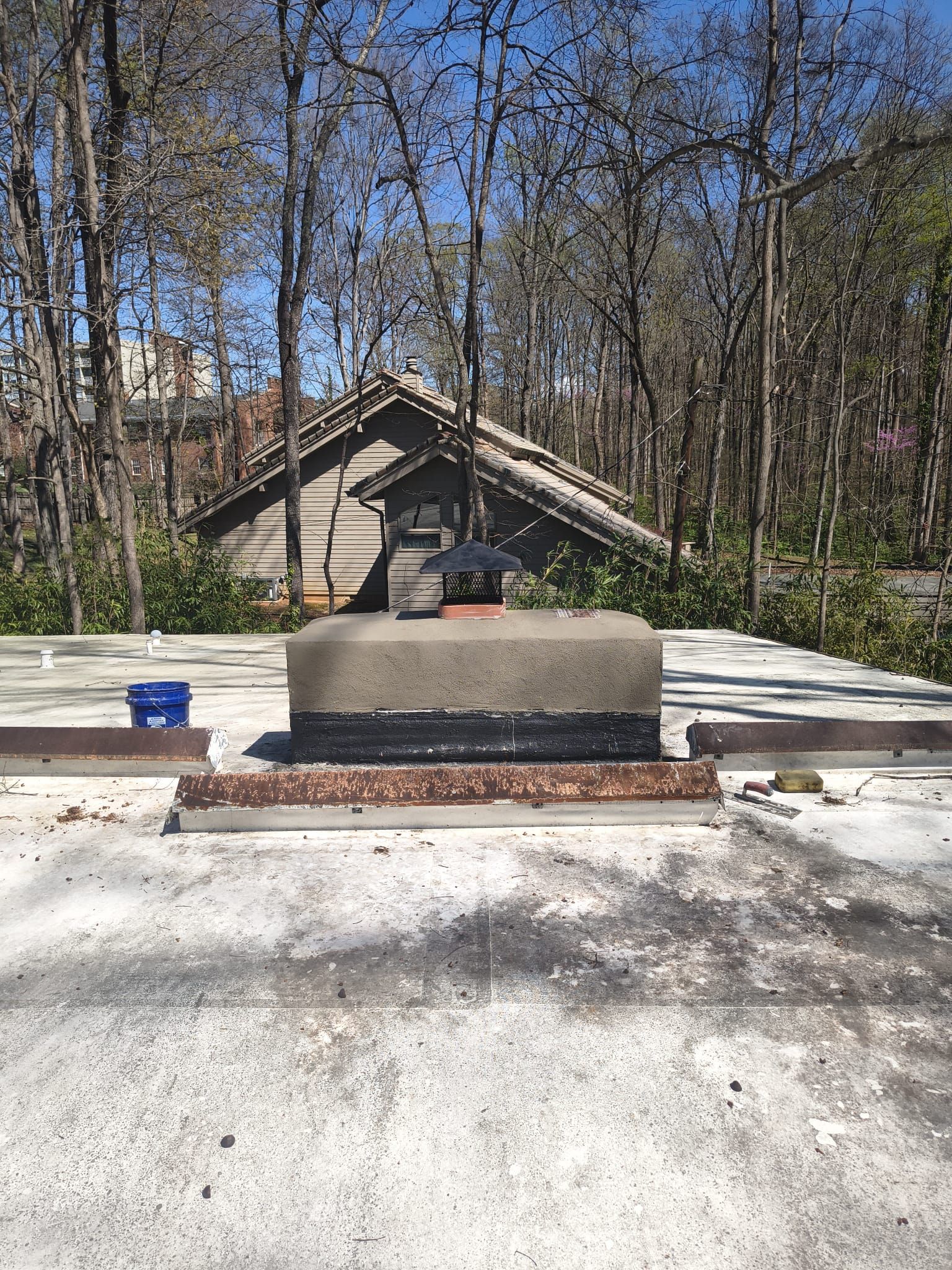
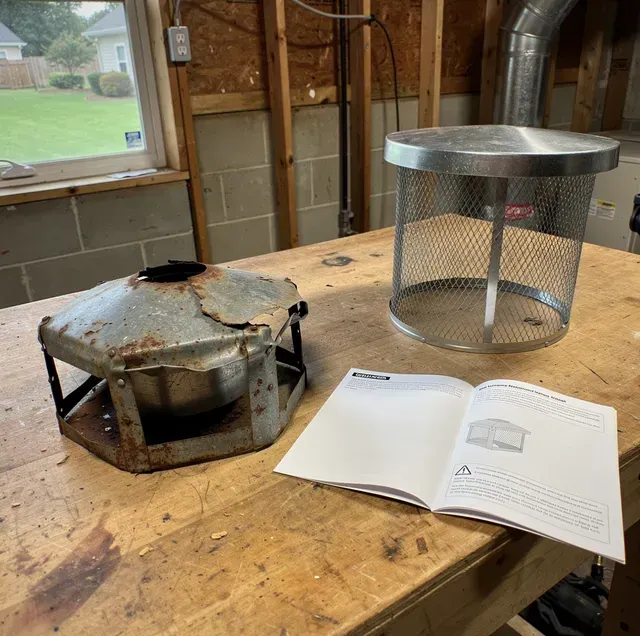
"Galvanized" sounds like a guarantee. The word gets used almost interchangeably with "rust-proof" in casual conversation, and a shiny new galvanized cap really does look immune to weather for the first few years you own it. It isn't rust-proof. It's rust-delayed: the zinc coating on a galvanized cap is a sacrificial layer with a finite amount of material, and each cycle of moisture reaching the cap consumes a little more of that layer. Once the zinc runs out at a given spot, the bare steel underneath starts corroding just like any unprotected steel would. The coating didn't fail because it was defective. It failed because using itself up is the job it was built to do.
That distinction matters because the "galvanized equals rust-proof" assumption leads to a second, more consequential misread: treating the first orange-brown spots you see on a cap as purely cosmetic. They aren't always cosmetic. Depending on where the rust shows up and what color it's turned, it can mean the coating is simply doing its job in that one spot, or that the steel itself has already started corroding. Telling the two apart comes down to understanding what's actually happening at the metal's surface, not just what it looks like from the ground.
What Galvanizing Actually Does to Steel
Hot-dip galvanizing bonds zinc to steel, and on a chimney cap, that coating is almost always applied to flat sheet stock in a continuous line before that steel is ever cut, drilled, or formed into the cap's crown, mesh screen, and legs. The zinc bonds to the surface and forms a series of zinc-iron alloy layers, capped with a layer of pure zinc. That coating protects the steel two ways at once. First, it's a barrier: it physically seals the steel from air and moisture. Second, and more important, once the barrier gets scratched or worn thin, it acts as a sacrificial anode. Zinc is more chemically reactive than iron, so when both metals are exposed to moisture together, the zinc corrodes preferentially and gives itself up to protect the steel next to it. It's the same principle behind the anode rod inside a water heater tank, sacrificing itself so the steel tank doesn't have to.
That sacrificial behavior is also why the protection has a limit. The zinc layer only holds so much material. Every corrosion cycle consumes a measurable amount of it, and once a given spot runs out of zinc to give up, both the barrier and the sacrificial protection are gone there, and the exposed steel starts rusting on its own.
Why Flue-Gas Condensate Speeds Up the Reaction
Plain rainwater is already enough to run the galvanic reaction described above, but a cap doesn't just see rainwater. It sits directly over the flue opening, which means it's also exposed to whatever the flue exhausts. In a wood-burning system, that includes water vapor along with condensed byproducts of combustion, some of which run acidic rather than neutral. As those gases rise and meet the cooler metal at the top of the flue, some of that vapor condenses right on the underside and edges of the cap instead of blowing clear. Acidic moisture drives the zinc-consuming reaction faster than plain water does: condensation forms on the cap at every cold start and again as the flue cools down, on top of ordinary rain and dew — more wet-dry cycles per year than the same metal sees anywhere else on the house.
Where the Coating Fails First
The zinc coating isn't uniform across the entire cap, even when brand new. Cut edges, drilled screw holes, crimped seams where panels meet, and weld points on the mesh screen are all spots where fabrication can thin the zinc layer or leave bare steel that never got coated at all, because holes are frequently drilled and edges trimmed after the galvanizing bath, not before. Those spots are usually where you'll see the first hairline of red rust, well before the flat crown of the cap shows any change. It's also why two caps of the same material and the same age can rust at noticeably different rates: one installed with hardware that bites through the coating at an odd angle, or one whose mesh was field-cut to fit rather than factory-sized, exposes more bare edges to moisture from day one. Most of the difference technicians see between one job's cap and the next traces back to fabrication and installation details like these, not to a difference in the metal itself.
TIP: Check the mesh screen's weld points and the screw heads first. Those factory-cut edges and fastener penetrations have the thinnest zinc coverage on the whole cap, so red rust usually shows up there years before the flat crown changes color. (336) 604-6711.
From White Haze to Red Rust: Reading What You See
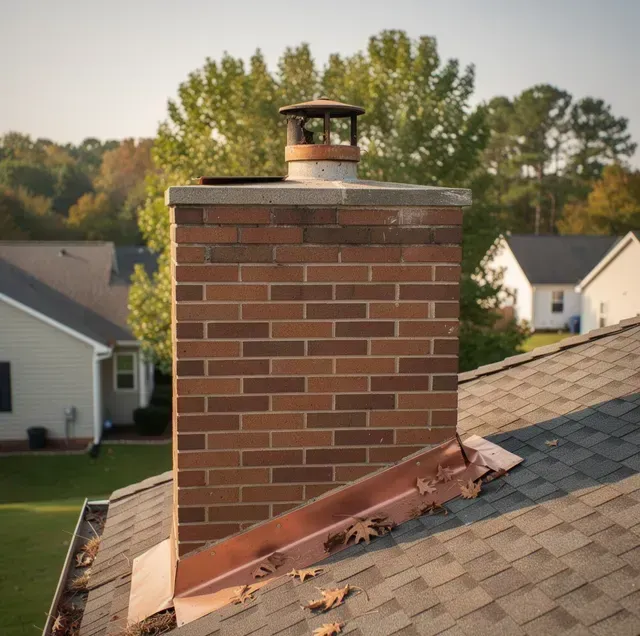
Not every discoloration on a galvanized cap means trouble. Fresh zinc coating often develops a dull gray-white haze early on, sometimes called white rust or zinc patina, which is really zinc oxide and zinc carbonate forming as the coating weathers in and reacts with air and moisture. That haze is largely stable and part of how galvanizing is supposed to age; it isn't the cap failing. What you want to watch for is that gray haze giving way to flaky, orange-brown rust in the same spot. That color change means the zinc at that location has been used up, and the iron in the steel is now oxidizing directly. At that point, the sacrificial protection there is gone, not just faded, and the steel will keep thinning wherever moisture keeps reaching it. Left alone, the pattern runs from surface staining, to pitting, to a thin spot that gives slightly under light pressure, to an actual hole at a seam or fastener point, usually the same locations identified above as the first to lose their coating.
The Same Mechanism Shows Up on Chase Covers
A cap isn't the only galvanized component on a chimney system that goes through this. Factory-built (prefabricated) chimneys typically have a separate chase cover, the flat metal lid closing off the top of the chase, and when it's fabricated from galvanized steel, it loses its zinc coating through that same sacrificial process.
WARNING: Getting close enough to check a cap or chase cover for pinhole rust means working at roofline height on a sloped or wet surface. Inspect from the ground with binoculars first, or have a technician check it during a routine visit. (336) 604-6711.
What Zinc Loss Tells You About the Cap
Rust on its own doesn't tell you much. What matters is where it is, what color it's turned, and whether it's tracking the pattern above: gray patina staying put versus orange rust spreading from a seam or fastener. Zinc running out eventually isn't a flaw in the cap; that's the protection working exactly as designed, right up until it's spent. What decides whether that matters to you is whether it gets caught while it's still surface-level or after the underlying steel has already thinned. A cap that's holding gray patina everywhere and red rust nowhere is doing fine. One with orange rust creeping along a seam or around the screws is telling you the zinc there is already gone.
Frequently Asked Questions
Does painting over rust stop it from spreading?
Not for long. Paint is only a barrier, and applying it over loose rust scale without first removing that scale can trap moisture against the steel and accelerate pitting underneath rather than slow it. Once rust has actually eaten through, the fix isn't a coating: it's a replacement cap, measured on-site and custom-fabricated to fit.
Can a rusted galvanized cap be re-galvanized instead of replaced?
Not in any way that restores the original protection. Hot-dip galvanizing forms a true metallurgical bond, layered zinc-iron alloys fused into the steel, that only forms in a galvanizing bath. Field treatments like cold galvanizing compounds or brush-on zinc-rich coatings sit on top of the existing surface rather than bonding into it, so they don't stop pitting that's already underway beneath a thinned spot.
Why does the mesh screen rust before the flat top of the cap does?
Mesh screening is usually thinner-gauge wire than the crown and legs, so each strand starts out with less zinc to lose in the first place. Once rust reaches the wire itself, it eats into that thinner cross-section faster than it would on the solid crown, and a strand can lose enough material to weaken or gap before the color change alone is obvious enough to catch from a distance.
Does the appliance below the chimney change how fast the cap rusts?
Somewhat. A wood-burning flue carries condensed combustion byproducts that tend to be acidic, which accelerates zinc loss. A gas appliance or gas log set burns cooler and cleaner, but efficient gas combustion often carries more water vapor relative to heat than a wood fire does, so a cap over a gas flue isn't automatically better off. Either way, the mechanism causing the damage is the same acidic condensate exposure described above.
Does the type of screw holding the cap down affect how it rusts?
Yes, if it isn't the same metal as the cap. Stainless steel screws are common attachment hardware, and stainless resists corrosion better than the zinc coating around it, so at that screw hole the zinc ends up sacrificing itself to protect the stainless fastener in addition to the cap's own steel. That's one reason the coating right around a screw head can thin out faster than the zinc a few inches away on the same panel.
How can you tell if rust has actually eaten through, versus just heavy surface staining?
Heavy surface rust can look alarming without being a hole yet, and that call isn't safe to make from the ground or by touch. On site, a technician checks from underneath for pinpoints of daylight coming through the metal and examines suspect spots directly for the kind of flex that surface staining alone won't show. The photographs taken during that visit are what let you see the difference afterward, so you're deciding between monitoring and replacement based on evidence rather than a guess.
Schedule a chimney cap inspection — a CSIA-certified technician can tell you whether that rust is surface-level zinc wear or a sign the cap needs replacing. Perfect Chimney Cleaning serves Greensboro, High Point, and Winston-Salem. Call (336) 604-6711.
Recent Posts